
 Pin it
Plan the child or doll version with the correct size column, yarn amount and ribbed trim.
Source: Yarnspirations, Poncho for You and Me (BRC0307-003844M).
This independently written planning companion uses US crochet terminology. The accompanying Reel is an AI-generated illustration, not a verified finished sample or a stitch tutorial. The complete pattern is not reproduced here. Find the official PDF on Yarnspirations by its exact name and code for executable instructions.
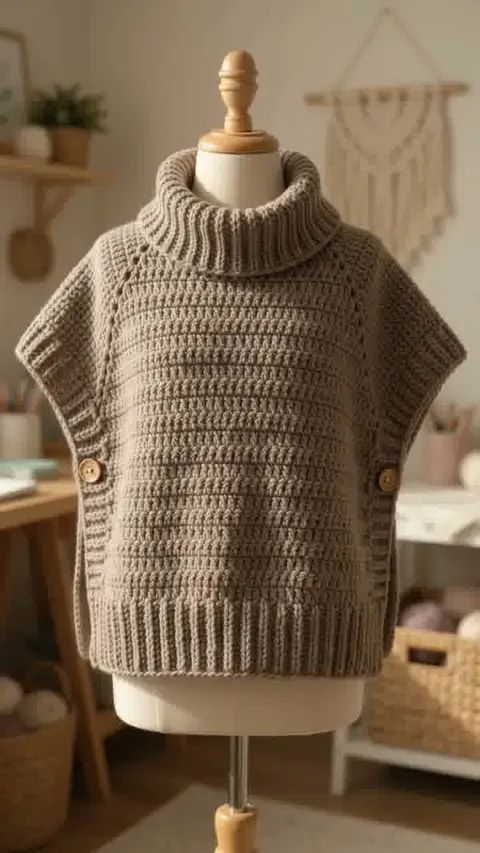
The visual simplifies the side trim to one visible button per side and uses an approximate body texture. The PDF calls for four buttons and its specified alternating stitch pattern; follow those written instructions rather than counting details in the Reel.
Read the material and size specifications
This Easy Bernat pattern includes child sizes 2, 4 and 6 years, for chest measurements of 22, 24 and 26 inches, plus a separate version for an 18-inch doll. It uses Super Value, specified as 197 g and 426 yards per ball. Child sizes require 2, 2 and 3 balls; the doll version lists one ball. The suggested hook is 6.5 mm.
Understand the construction
The stated gauge is 10 single crochets and 11 rows per 4 inches. Front and back pieces use alternating single and double crochet, with separate slip-stitch ribbing at the collar and sides. Each garment has four decorative buttons. The doll instructions have their own counts and should not be treated as a scaled photocopy of the child instructions.
Choose one set of numbers
Mark the intended size throughout the PDF before starting. Keep the doll section covered while working the child version, or make a separate note page for it. A measurement label such as chest or panel length is useful beside each number so unrelated dimensions are not confused.
Compare the trim with the body
The ribbed sections and textured body behave differently. Keep a small sample of each beside the project and judge how comfortably they meet. Measure the ribbing relaxed before sewing so it neither gathers the body unintentionally nor hangs loosely along the edge.
Check the decorative details
Place the buttons temporarily and compare their spacing before fastening them. They are decorative, so do not invent buttonholes from the illustration. For a garment intended for a child, assess the actual finished attachments and fit; the generated picture does not establish suitability.
Before You Start
Keep the official PDF, your measurements and your swatch notes together while planning the project.